

Dear friends,
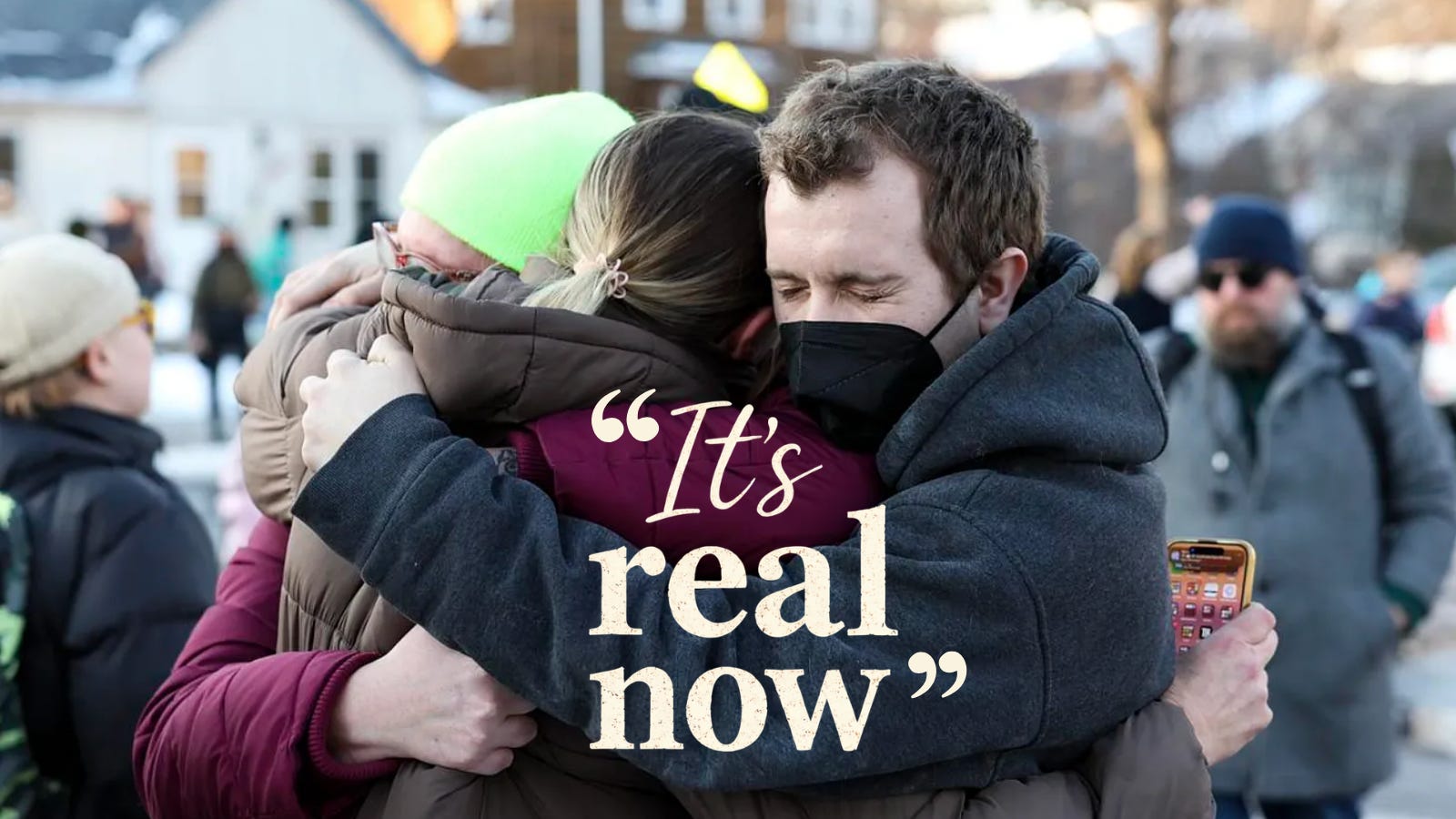
As I was talking with a close friend about the ICE operations in Minneapolis, she paused and whispered: “It’s real now.” In that moment, the abstract became personal— an experience many of us know but rarely name. She had witnessed the increasingly cruel ICE operations, including the deaths of observers Renee Good and Alex Pretti — events that had shaken her deeply.
Though spoken softly, her words carried the force of a shout. The cruelty had broken through. She had seen ICE agents in military-combat gear, gunshots in the air, and the screams of bystanders.
The truth of it moved her. She feared the hateful acts would continue, unrelenting. As that realization sunk in, she began to worry about what it meant for our country.
Up until that moment, my friend had followed pro-democracy resistance efforts in the news. But the cruelty of the ICE operations had felt distant as she dealt with challenges in her own life. What she saw in Minneapolis had pierced her heart.
Her quiet phrase stayed with me – steady and unsettling. Weeks later, it resurfaced in a very different setting: my monthly book club discussion.

Our selection was A Dry White Season by Andre Brink.1 As I prepared for the discussion, I found myself feeling cautious. The book’s depiction of state-sanctioned brutality carried unnerving parallels to what we had been witnessing in the United States – particularly the government’s punitive treatment of Black and Brown communities.
I found myself wondering:
Would we –or could we – explore those parallels during our discussion?
The day before our meeting, one of the organizers sent the usual reminder with the time, book title and facilitator name. Then he added a note: “FYI, I just finished this book, and I was moved by how this novel, centered on the issues of apartheid South Africa, is relevant to today’s issues.” His comment eased my hesitation.
Our discussion the next night stretched longer than usual. For the first time, people spoke openly about the recent killings and the videos showing children running to escape ICE. These images could not be “unseen,” and their emotional weight settled heavily over the room. For many, the line between the apartheid regime in South Africa and our present reality no longer felt distant or abstract.
Toward the end of our conversation, we focused on the final paragraph in the book’s epilogue. There, the author writes,
“Perhaps all one can really hope for, all I am entitled to, is no more than this: to write it down. To report what I know. So that it will not be possible for any man ever to say again: ‘I knew nothing about it.’”2
The author’s words echoed through the room, and crystallized a shared realization. We, too, could no longer say we knew nothing. We had seen the images, heard the sounds, felt the horror. The reality was undeniable. It was real now.
These conversations – with my friend and with my book club – led me to another question.
How does reality break through?
I often turn to William James, whose work on perception has helped me better understand how change takes hold. In his chapter, “The Perception of Reality,” William James offers insight into how something becomes real for us. For an object to become real, he writes, it “must not only appear, but it must appear both interesting and important…”3 We relate to it practically and emotionally, and that response creates a sense of human connection.
When something feels real, we believe it. We find it compelling enough to pay attention to it, to “fill our mind with it.…. and accept it.”4 In contrast, when something feels unreal, we disbelieve it. We ignore it, forget it, dismiss it, fail to act.
Minneapolis offers a vivid example of how reality broke through for many people.
Visible coverage of cruelty
Residents’ actions helped ensure that the ICE operations remained visible, rather than hidden or forgotten. Media coverage made these events impossible to deny. Videos, photos, and observer live-streams connected front-line experiences to people’s emotional lives. Commentators noted that people had now seen this with their own eyes. Many had seen the widely-circulated photo of Liam Conejo Ramos – the little boy with a backpack and hat, whom ICE agents used as bait to capture his father, before detaining him as well. For many, especially parents, that single image made the cruelty tangible. An NPR survey5 later found that nearly two-thirds of Americans believed ICE had gone too far.
Organized compassion
At the same time, Minneapolis residents responded with organized compassion and protection for their neighbors.6 News reports and community posts allowed people near and far to witness this care in action. Community groups offered vehicle monitoring and ‘know your rights’ training for families in hiding. Through livestreams, we saw teachers forming protective lines at school entrances, volunteers walking children safely to class, and neighbors delivering food, diapers and other essentials while coordinating mutual aid schedules.
This formidable combination–exposing cruelty while demonstrating compassionate care–created powerful conditions for reality to break through. The stark contrast between the two made both more visible.
The ongoing, heartfelt actions of Minneapolis residents – and of Minnesotans more broadly - have inspired many across the country. These are not abstract concepts. They touch our hearts.

And so, I find myself asking: What will I do now that I can no longer look away?
When reality breaks through, it doesn’t just inform us—it touches us. It unsettles us. It asks something of us.
I feel it in my own chest: a tug to stay present, a voice insisting, You can’t unsee this.
For me, that tug has become a promise—to pay closer attention, to listen with deeper intention, to contribute in small but steady ways for safe and fair elections, and to lift up the stories of those on the frontlines of change.
I don’t have all the answers. But I do know this: turning away is no longer an option.
Your own response will likely look different. It might begin with a conversation you’ve been meaning to have, a relationship you want to nurture, a local mutual-aid effort you’ve been watching from afar, or simply a decision to stay open – even when that openness feels uncomfortable.
Reality has broken through. Now, in whatever way feels right and true, it’s our turn to respond.
Change doesn’t happen alone,

P S. I’m curious: When has something suddenly become “real” for you — a moment when you could no longer look away?
Brink, Andre. 1980 A Dry White Season. William Morrow and Company.
Brink, Andre. 1980. A Dry White Season, page 310. William Morrow and Company
James, William. 1980. The Principles of Psychology. Volume 2:. page 295 Dover Publications
James, William. 1980. The Principles of Psychology. Volume 2:. page 295 Dover Publications
Loffman, Matt. February 5, 2026 Poll: Nearly two-thirds of Americans say ICE has gone too far in immigration crackdown
https://www.pbs.org/newshour/politics/poll-nearly-two-thirds-of-americans-say-ice-has-gone-too-far-in-immigration-crackdown
Rodriguez, Barbara. February 3, 2026. “We have to keep showing up for each other: In Minnesota, Caregiving is a form of resistance.” 19th News. https://19thnews.org/2026/02/minnesota-mutual-aid-caregiving-ice-resistance/
Karen, This is so stirring—and well written. It most definitely has me thinking about what I need to do, agreeing that we cannot not see.
Thank you for your showing up in this way and thereby challenging me to do so.
Don