


I first learned about the Buddhist Monks’ Walk for Peace1 when local news reported their path would bring them to the Atlanta area, near my home.
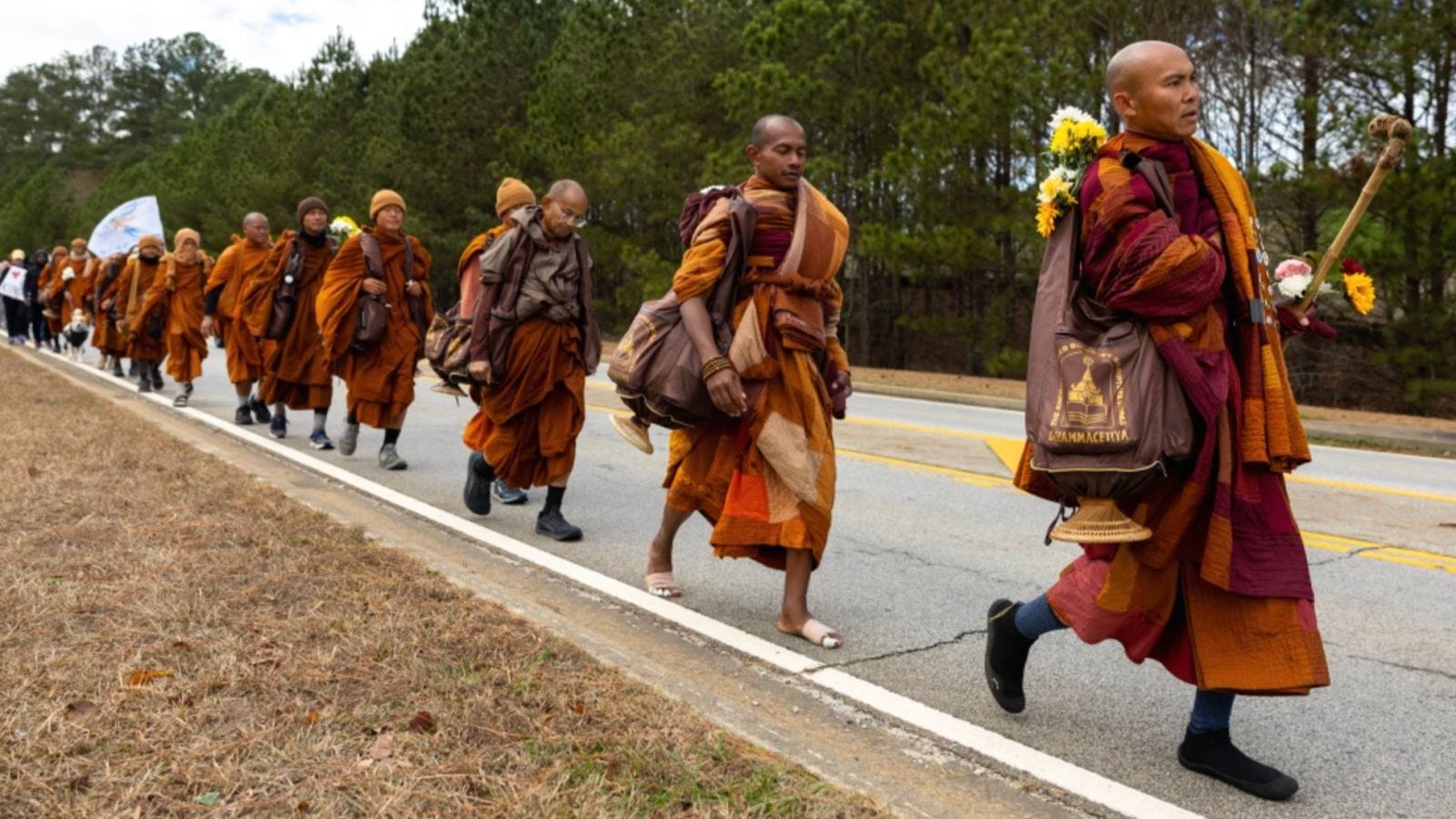
Having departed from Fort Worth Texas on October 26th, 2025, they are expected to arrive on February 13th in Washington, DC. In between departure and arrival, they will travel 2300 miles on foot through ten states.
Their mission? “To raise awareness of peace, loving kindness and compassion across America and the world.2”
The Walk for Peace immediately captured my attention. It is unfolding during a moment when our country needs it most—when peace and kindness feel increasingly difficult to find amid hateful acts, political fracture, and a constant sense of urgency. When everyday moments of joy and wonder feel fleeting, the sight of monks walking mindfully for peace is a calm, powerful antidote to chaos.
A collective response
I soon realized I was not alone in wanting more peace and kindness. The monks captured many others’ attention!
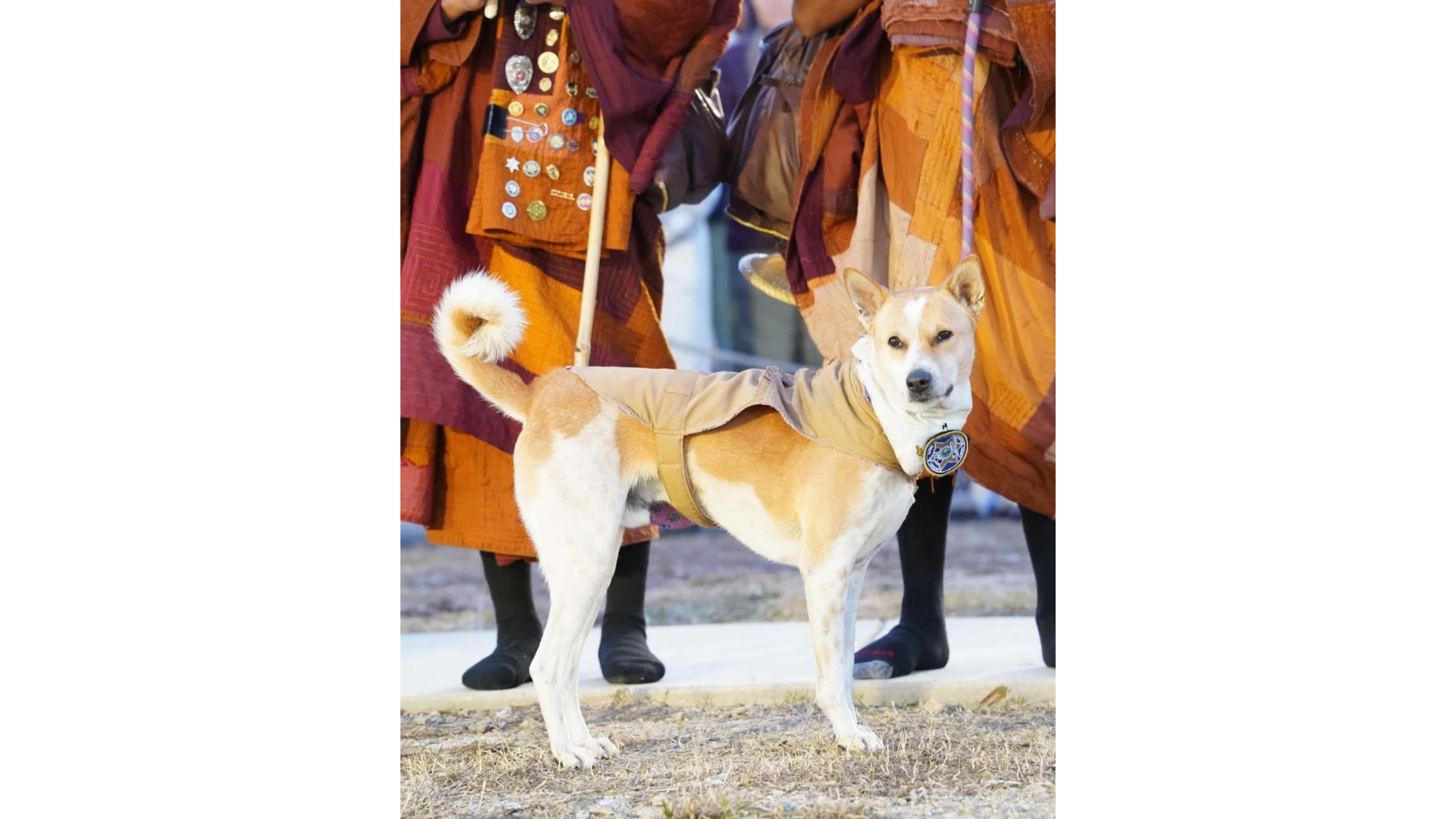
Despite a severe drop in temperature just as the monks and their Peace dog, Aloka made their way through Georgia, thousands of people lined the streets to welcome them, and others gathered in the venues where the monks offered peace-sharing events.
Take for example, Morrow, Georgia, a town south of Atlanta. Although it has a population of just 6500, twenty thousand people gathered along streets to welcome the monks and later at the Morrow Center to participate in a “peace-sharing talk.” Led by the Venerable Bhikkhu Pannakara, the monks shared this message:
“If there is no loving kindness, there is no peace. If there is no compassion, there is no peace. Loving kindness means we love everyone equally. If we don’t have peace within ourselves, we cannot expect anybody to bring us peace…”
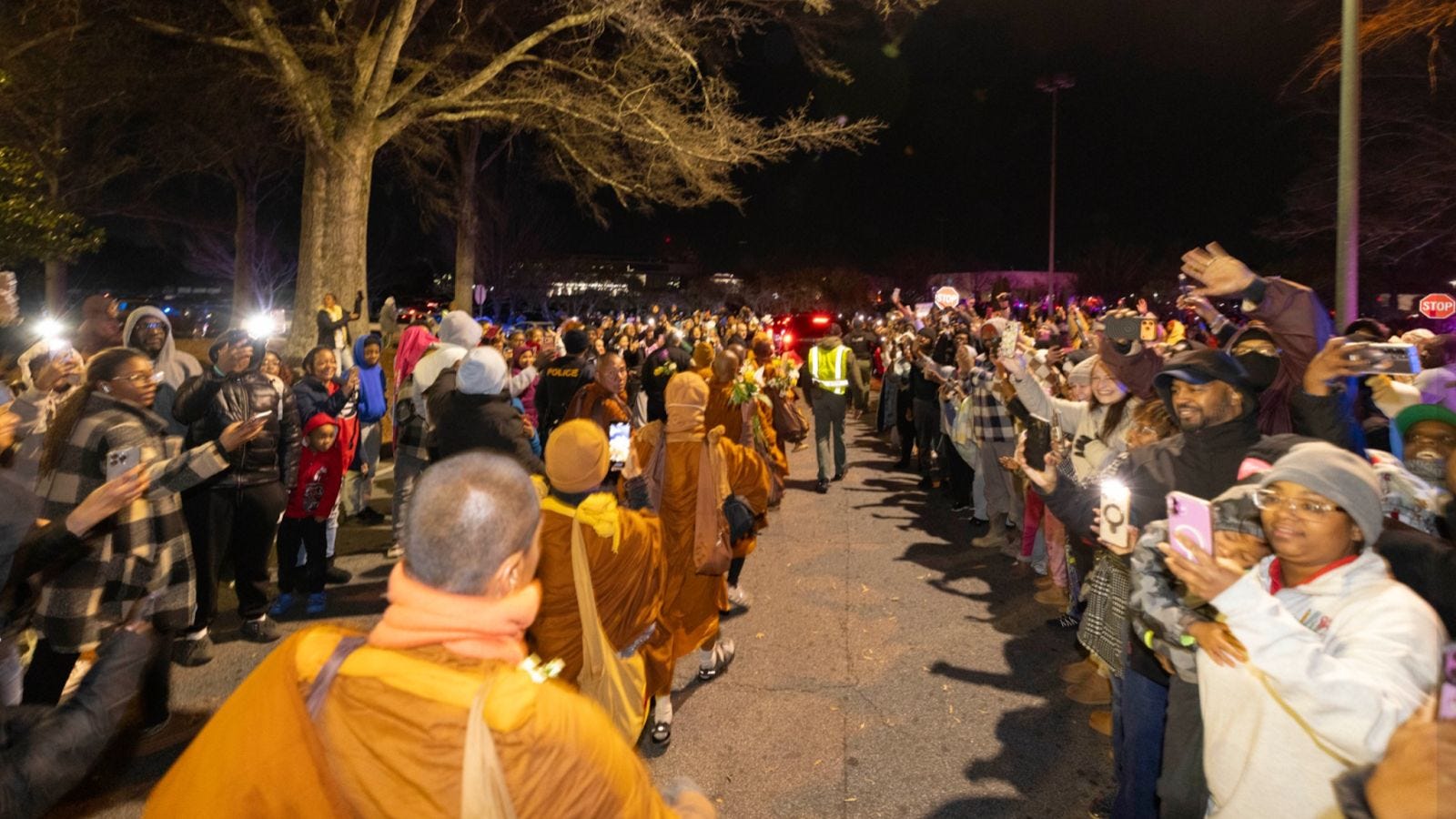
In Fayetteville, Georgia, Arvin Temkar, a photojournalist on assignment for the Atlanta Journal and Constitution captured the enthusiasm and joy of thousands of people waiting for the monks to arrive. “Though I knew there would be some curious onlookers,” he commented, “I hadn’t anticipated the size of the crowds – or the excitement.”
“They waited on the grassy shoulder of Veterans Parkway in Fayetteville. They waited on foot and in lawn chairs, seated in sedans and standing atop the beds of trucks. They waited outside homes and on sidewalks along storefronts.3”
When asked why she came out to see the monks, one woman responded, “For peace and love because we need that in America right now. I think it’s a great reminder for all of us to return to our peace and our inner peace.”
State representative for the area, Josh Bonner, responded, “They’re [the monks] just humble folks trying to bring awareness to peace, and everybody can get on board with that.”
The following day, the monks arrived in Decatur. Thousands again greeted the monks, including elected officials. During his remarks, US Senator Raphael Warnock shared: “…We can certainly use a lot more kindness. “They’ve [the monks] taught us how to walk humbly, literally walking humbly.”
State representative Ruwa Romman noted that many of those present had been there for “seven, eight or nine hours.” Earlier she asked them why they were there. “A lot of you said because you feel deeply troubled and want a moment of community.”
Arvin Temkar expressed the moment.
“As a photojournalist, I see fear too often. It’s no wonder people are so drawn to the monks. They offer a nonpartisan, universal message: Peace is possible. Peace is a choice...”
The monks’ final stop in the Atlanta area was a special visit in Snellville, location of Wat Lao Buddha Khanti. There they met with Venerable Maha Dam Phommasan, who had joined the Walk for Peace. In mid-November, the monks were involved in a serious accident near Houston. Sustaining severe injuries, his leg had to be amputated. After a month of treatment, he returned to his temple in Snellville—not able to physically walk with the monks. Later, Venerable Bhikkhu Pannakara shared in writing:
“This is what the Walk for Peace truly means—not just the miles we cover, but the love that binds us and the hearts that never let go, even when separated by circumstance.”
Beyond Georgia, similar numbers of people are lining the streets to welcome the monks. Now The Walk for Peace also has a strong social media presence. At the time of this writing, the monks had 2+ million followers on Facebook and 1.5+ million followers on Instagram. Their loyal Peace dog, Aloka had 375,000 followers on Instagram and 833,000 on Facebook.
As Neeraj Bajracharya, government liaison and press coordinator for the walk, explained, “The core, foundational stone of this initiative is peace, unity, compassion and healing. And we want to reach out to each and every individual in America.4”
The story of the Walk for Peace is all about walking mindfully with others, a practice especially useful in chaotic and uncertain times.
Once we learn to walk mindfully, we can draw on our practice to develop better responses in difficult situations, and to foster hope and resolve.
Walking mindfully
Think for a moment before continuing to read. How do you usually walk? What would an anthropologist see if they were observing you walking? Is your pace fast? Or slow? What about your breathing? Are you aware of your walking while you walk?
We generally don’t think much about walking when we’re walking. Our minds go elsewhere. Maybe we’re planning or worrying about what we need to do when we get to our destination. Or are trying to catch a train. Or fast walking because we are late for the meeting. As the Buddhist monk, Thich Nhat Hanh cautioned in How to Walk5, “We’re in such a rush...We walk like sleepwalkers, without any enjoyment of what we are actually doing. …”
Walking mindfully is different from how we usually walk. The monks are walking mindfully as they walk for peace. Their walking is neither taken-for-granted, nor focused on the destination. Rather, as they walk, they are aware of their walking. They are deeply in touch with a moment they encounter in the ‘here and the now.’
We, too, can walk mindfully. We become aware of our walking, noticing how we breathe and the steps we take. Mindful walking helps break through the busyness that can fill our days. “Each mindful step says, “ I don’t want to run anymore. I want to stop. I want to live my life. I don’t want to miss the wonders of life.6”
Walking mindfully also helps us more readily pause to reflect on and consider how we want to respond to challenging situations. Pausing doesn’t mean ignoring thoughts or concerns. It means calming. Recent studies demonstrate that taking intentional pauses may generate more creative solutions for change7 and improve strategic decision making.8
PRACTICE: Walking mindfully
Excerpted from How to Walk9
Try this practice to develop the awareness of walking as you’re walking.
Stop thinking about the past or future. Just walk.
“The first thing to do is to lift your foot. Breathe in.
Put your foot down in front of you, first your heel and then your toes. Breathe out. Feel your feet solid on the Earth. You have already arrived.10”
Before the Walk for Peace, I knew about mindful walking—but I had never actually tried it. Walking, for me, was about getting somewhere or getting “fit.”
I’ve begun practicing—slowly and imperfectly. I even started a small journal to notice what’s happening along the way and to keep myself from slipping back into autopilot. What I know for sure so far? I am awkward at this. And that feels like part of the learning.
If you’ve experimented with walking mindfully—or are curious to try—I’d love to hear what you notice. I’ll be continuing this reflection in February, as I explore what it means to walk mindfully with others.
Change doesn’t happen alone,

Be sure to subscribe to Change Chronicles. In the next Substack we will continue following the Monks and their Walk for Peace and how we can apply this to our work and life.
You are receiving this Substack because you have subscribed to Karen’s newsletters. If you would like to be taken off the list, unsubscribe below.
Website link for The Walk for Peace: https://dhammacetiya.com/walk-for-peace/
Maya T. Prabhu. Dec 29, 2025, The Atlanta Journal–Constitution. https://www.ajc.com/news/2025/12/buddhist-monks-spread-awareness-as-walk-for-peace-travels-through-atlanta/
and
Arvin Temkar. Jan 8, 2026, The Atlanta Journal–Constitution. https://www.ajc.com/opinion/2026/01/buddhist-monks-walking-for-peace-are-what-beleaguered-america-needs-right-now/
Arvin Temkar. Jan 8, 2026, The Atlanta Journal–Constitution. https://www.ajc.com/opinion/2026/01/buddhist-monks-walking-for-peace-are-what-beleaguered-america-needs-right-now/
Adam Gabbatt. Jan 17, 2026, The Guardian. https://www.theguardian.com/us-news/2026/jan/17/buddhist-monks-walk-for-peace
Thich Nhat Hanh. 2015 How to Walk p 19. Parallax Press.
Thich Nhat Hanh. 2015, How to Walk p 69. Parallax Press.
Karen Golden-Biddle. 2024, The Untapped Power of Discovery. Routledge.
Geoff Tuff, Steve Goldbach, and Jeff Johnson 2024,Harvard Business Review. https://hbr.org/2024/01/when-an-active-pause-is-the-best-strategic-choice
Thich Nhat Hanh 2015 How to Walk p 7. Parallax Press.
Loved this-- I could feel myself breathe more easily. Thanks Karen!
Karen, I really enjoyed your writing about mindful walking. I have been practicing mindfulness throughout my day for a number of years since I retired. I am learning how to be present, and to stay out of the past and the future. Thank you for your reflections on the march, too