


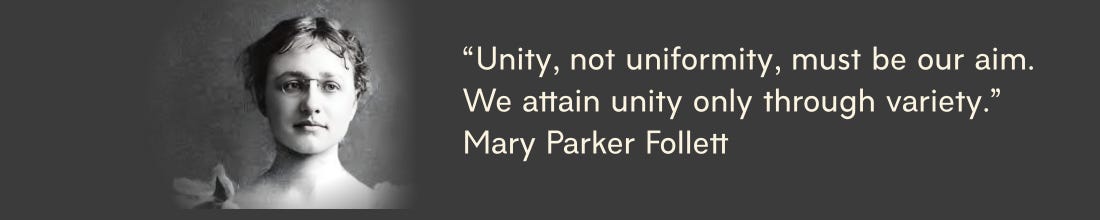
What does it take to bring people together—without asking them to become the same? One of the hardest parts of creating change in large groups is uniting people through their differences around a common purpose. Our habit is to reach for control. Some leaders seek “buy-in.” Others issue top-down mandates, or point to metrics detached from lived experience. But control flattens difference, and the pattern is predictable: impact falls short, momentum fades, and people conclude this change, too, will pass.
Creating unity without uniformity
Control can’t create unity. But what does? The same dynamic I’d seen inside organizations is now unfolding across our public life too. That question sharpened as I listened to national leaders discuss plans for the first march and rally. In my journal at the time, I wrote:
“I was struck first by the name: Hands Off! The protest wasn’t being organized around a single issue. Nor were people asked to prioritize one over another. Instead, people were invited to protest whatever they wanted the administration to stop doing—to keep their “hands off” of...”
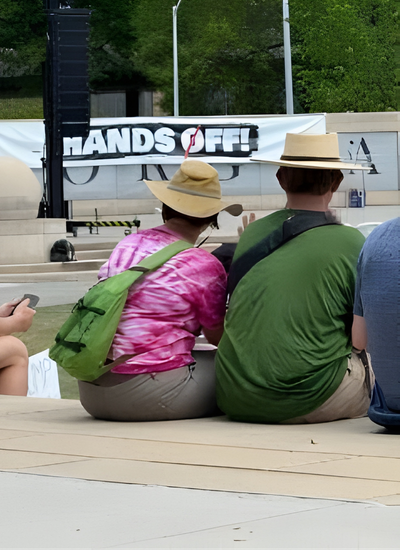
The framing pulled me in. It avoided the usual fights over which issue should take priority. Instead of dividing people into silos, the organizers chose a big-umbrella term, signaling that all were welcome. I thought of Mary Parker Follett’s insight that difference can be a rich source of democratic vitality. Our “aim,” she said, must be “unity, not uniformity.”
Curious, I continued to follow their weekly conversations, for more than a year now, and joined several marches. Drawing from these experiences and from Follett’s idea of integrating processes1, I examine how people can reach toward unity through variety.
That question became more concrete when I experienced it firsthand.
Protesting locally in Decatur, Georgia
No Kings 3 overflowed with joy, laughter and resolve. The day itself invited participation: bright, warm and clear. Thousands of people – young and old, across races and backgrounds – gathered on the grassy lawn of a local hilltop church, ready to march to the old Courthouse for the rally.
Colorful signs bobbed above the crowd. One read, “We, the People is a radical idea.” Others declared, “No Kings, No ICE, No War.” Everywhere you looked, there was joy: wide smiles, bursts of laughter, an easy sense of community. I unexpectedly saw my neighbor; we traded photos with our families and signs.
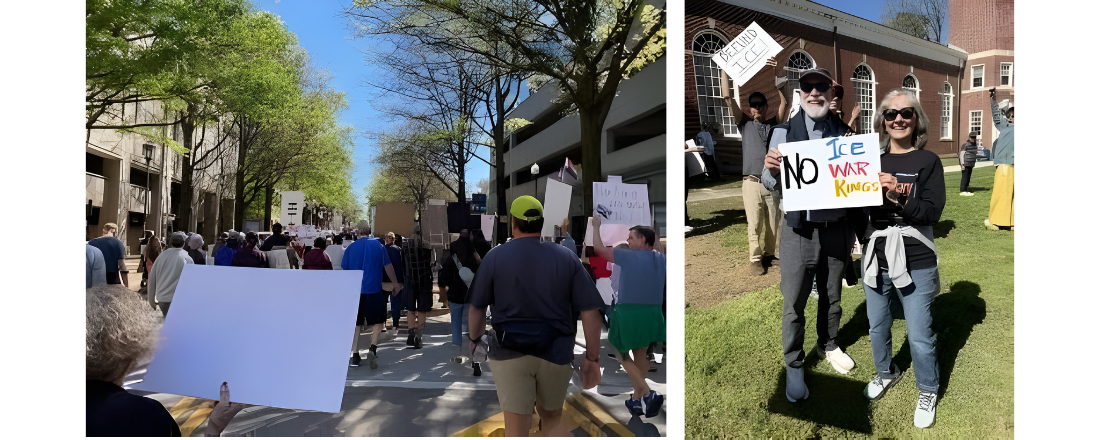
As the march began, Kermit the Frog led the singing, setting a playful tone. The organizer reminded us of the core norms of No Kings events: non-violence, care for each other, much joy.
The organizing team took this responsibility seriously. Marshals guided the large crowd down the steep hill to the starting point. Volunteers served as route guides, and medics stood ready. At one point along the route, a marshal stood guard over a pothole so no one would stumble – quiet acts of care that offered reassurance amid the celebration.
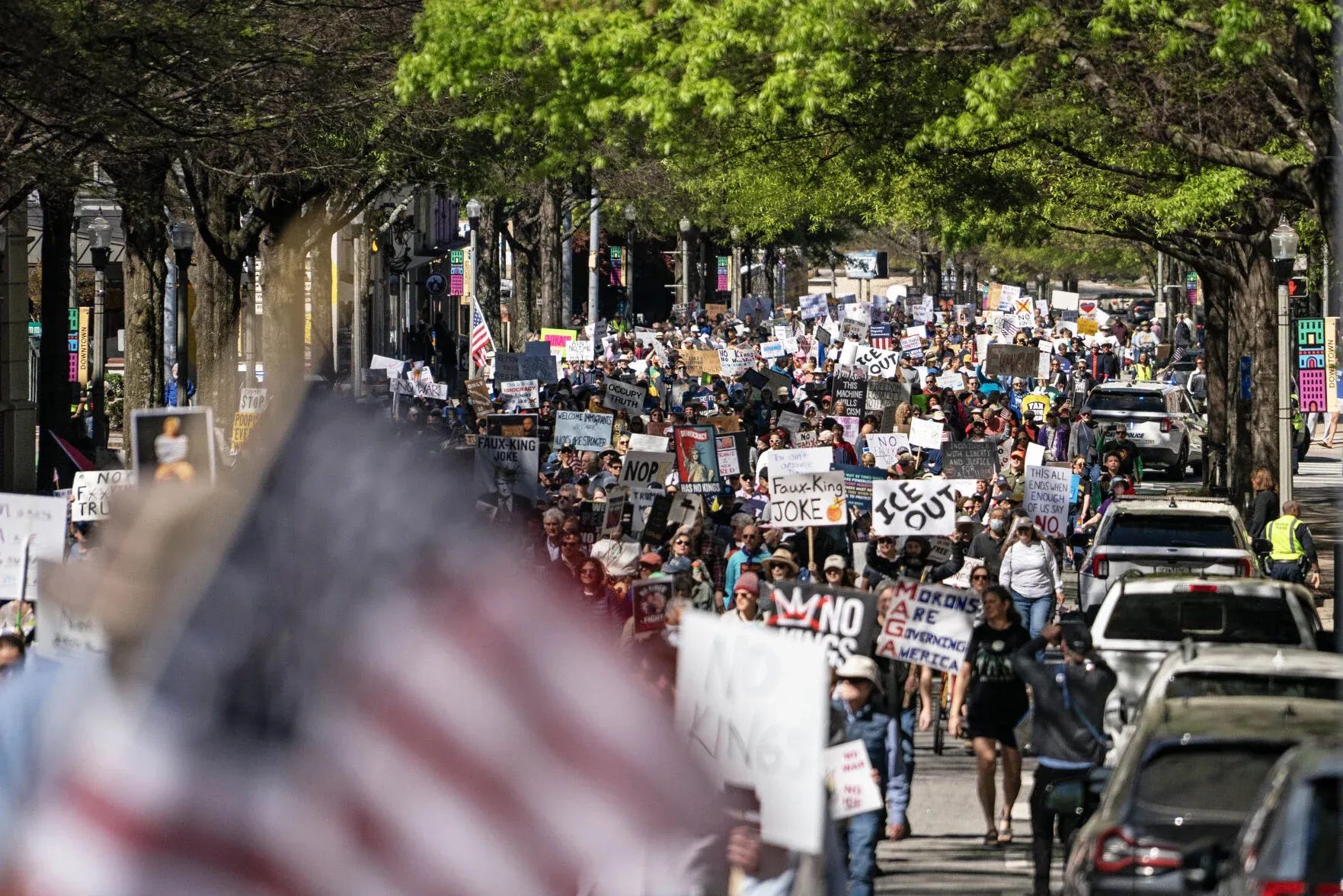
It was the largest turnout yet. When organizers announced that — for the first time — protestors would walk in the street rather than stay on the sidewalks, cheers erupted. We moved together, filling the mile-long stretch of road: our voices, our signs, and our joyful presence collectively claiming the space.
What the reporting didn’t see
After the march, I couldn’t wait to read the news. My experience suggested a movement not only growing in size but deepening in connection. People meeting neighbors, normalizing protest, building democracy muscles, having fun!
Early national coverage was thin. Articles were buried, untitled or reduced to small side boxes. Headlines drained energy. Stories focused on attendance numbers and lists of issues, paired with skepticism about continued growth. They missed the joy – the wide smiles, laughter and sense of community. That joy is not incidental; it’s both a respite from the anger and a source of unity and resolve.
When media flattens these events, it obscures the vibrant work of unifying and the momentum on the ground. People are not only resisting the cruelties of this administration, but they are also building a better future with the aim of unity.
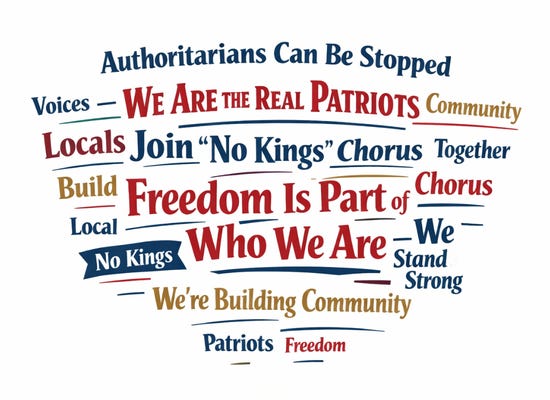
Two weeks later, the Democracy and Media Project2 confirmed this gap. Their analysis found that major national outlets were “insufficiently covering the pro-democracy movement and mass demonstrations.” Editors at The New York Times and Wall Street Journal “failed to capture the importance and patriotic pro-democracy energy… of the day of action.” By contrast, “many local editors “did a much better job …capturing what was happening on the ground. Local headlines and images highlighted joy, humanity and democratic commitment: “Authoritarians can be stopped,” “We are the real patriots,” “Locals join ‘No Kings’ chorus,” “Freedom is part of who we are,” “We’re building community.”
A big tent as convening structure
The pro-democracy movement is a “big tent” effort. Under banners like, “No Kings, No ICE, No War,” millions have participated in four marches in less than a year. There are now protests in every state and more events than counties in the United States. Participants span geographical, cultural, political, and other differences.
Follett saw difference, not as a divider but as a connector. Our task is to harmonize difference by integrating similarities and differences. Difference is “…that which unites us.3” A big-tent pro-democracy movement makes the power of variety visible.
National groups support local organizing efforts. Both offer training – marshals, medics, volunteer training, know your rights seminars, reading groups, nonviolence workshops. These structures help millions of ordinary people build the muscles to engage as active members—to protect rights through protest, at the ballot box, through boycotts and other forms of collective action.
Neighborhood logic
Local groups function much like what Follett called, “neighborhood organizations.4” We relate not to abstract society, but to the concrete groups around us. When the people we see at church, in the grocery store, or school pickup are also the people we see at a march, unity becomes tangible.
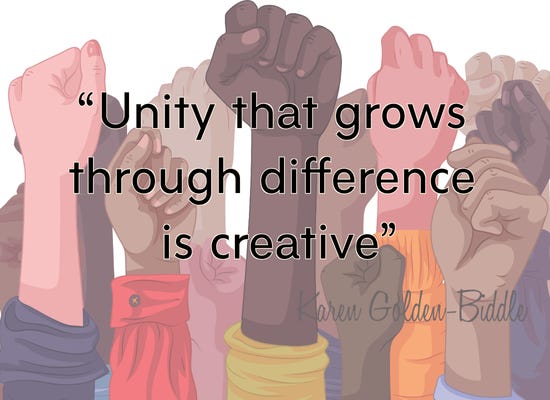
Neighborhoods, Follett wrote, offer the best opportunity to find unity in our differences, to live “…the consciously creative life.5” We are encouraged to bring our differences into everyday relationships– not erase them – because unity that grows through difference is creative. “Our faith in democracy,” she said, “rests ultimately on the belief that [people] have this creative power.6”
Responsibility to one another
Shared responsibility – to ourselves and to our neighbors – is the foundation of democratic life. I saw it everywhere during the No Kings march: the organizer helping people down the hill, the marshal guarding a pothole; volunteers guiding marchers to the rally. Marchers and organizers alike upheld the shared duty to sustain non-violence.
Neighborhood organizations, wrote Follett, have the responsibility “not to right the wrongs… but to … build more widely the right.7” Big tents with local neighborhoods—whether in place or temporarily formed in the streets—offer important training grounds for developing active, creative members responsible to one another for building more widely the right.
Now what?
If we look beyond attendance numbers and headlines, a different story comes into view: millions of people practicing democracy in real time.
The question isn’t only what this movement is doing. It’s what it might be teaching us—about how we show up and contribute to the communities we’re already part of.
In marches and training sessions across the country, people are learning to walk together, to listen across difference, and to take responsibility for one another’s safety and dignity.
These are not incidental behaviors; they are the everyday disciplines of democratic life.
These protests reveal not simply resistance to particular policies or leaders, but the emergence of creative, responsible citizens acting within a big-tent, pro-democracy movement. Follett warned that unity built on likeness alone is brittle. But unity that grows through difference — through harmonizing varied experiences, identities, and commitments — is generative.
Seen this way, the No Kings protests are not isolated events. They are training grounds for the relationships and local groups that sustain democratic life. They show how unity without uniformity becomes possible: not as a final achievement, but as a practice renewed each time people gather.
And this practice is open to all of us.
What’s happening in these marches is more than resistance. Each is a small proof that people who differ in countless ways can still choose to move together. The question now is how far we’re willing to carry that practice.
Democracy doesn’t grow on its own; it grows because people decide, again and again, to show up, to listen, to take responsibility for the space we share.
If you feel the pull, follow it.
The work is already underway—and there is room for you in it.
Change doesn’t happen alone,

Check out past issues


Follett, The New State.
Media and Democracy Project. Survey of NK3 media coverage. April 12, 2026.
Follett, The New State, 40
Follett, The New State.
Follett, The New State, 201.
Follett, The New State, 222.
Follett, The New State, 340
Thanks, Karen! A much deeper take on “protests.” Joy begets joy.
Thanks, Karen. Love the idea that “Unity that grows through difference…. is generative.” Creativity at its best.